Chapter 10
PART 10
Meera did not attend the first hearing.
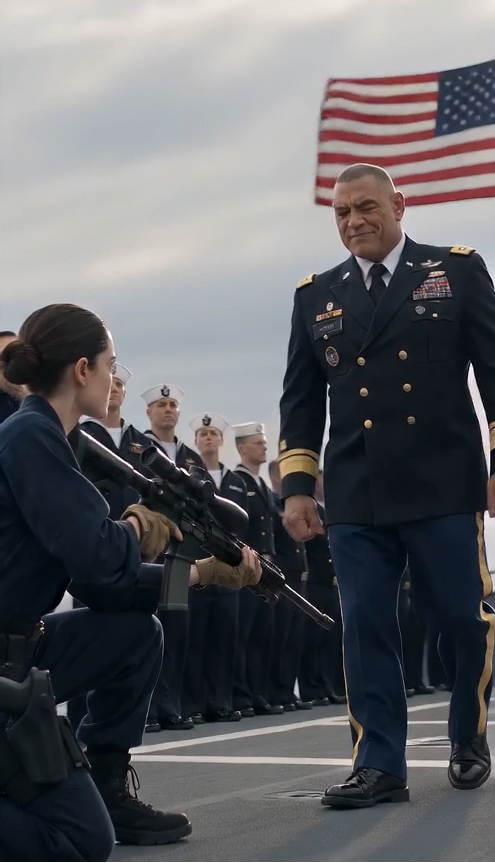
She was back on deck before sunrise, cleaning salt from the Barrett with a cloth and steady hands.
Mercer found her there.
The ocean was calm for once.
The American flag moved gently in the early light.
“You should be sleeping,” Mercer said.
Meera kept working.
“So should you.”
He stood beside her.
For a while, neither of them spoke.
Then Mercer said, “The file is corrected.”
Meera’s hand stopped.
“All of it?”
“As much as they can release.”
She nodded slowly.
“And Falcon Harbor?”
“Your name is back in the record.”
Meera looked out over the water.
The sun was just beginning to rise, turning the surface gold.
For years, that mission had lived only in her notebook.
A line of numbers.
A distance.
A shot.
A truth no one was allowed to say out loud.
Now it had a voice again.
Mercer reached into his pocket and handed her a small folded photograph.
Meera took it carefully.
It showed a group of civilians standing near an evacuation helicopter.
Men.
Women.
Two children.
One little boy held up a hand-painted sign.
THANK YOU, OVERWATCH.
Meera stared at the photo.
Her eyes filled before she could stop them.
“Where did you get this?”
“Allied archive,” Mercer said. “They sent it when the file reopened.”
Meera touched the edge of the picture with her thumb.
She had never seen their faces clearly.
That was the hardest part of long-range work.
You saved people you might never meet.
You carried the sound, the recoil, the risk.
But not always the proof that it mattered.
Now she had proof.
Not from medals.
Not from generals.
From the people who lived.
Her voice broke slightly.
“I thought they forgot.”
Mercer looked at the rising sun.
“They didn’t.”
Meera folded the photo and placed it inside her notebook, beside the 3,200-meter entry.
Then she closed the cover.
For the first time in years, the notebook did not feel like a burden.
It felt like a witness.
Later that week, the crew gathered again on the deck.
Not for a demonstration.
For recognition.
The captain stood before them and spoke plainly.
“No weapon is dead weight in the hands of someone who understands responsibility.”
He turned to Meera.
“And no soldier should be mocked for carrying the tool that keeps others alive.”
The crew applauded.
This time, no one laughed at her.
No one questioned the rifle.
No one called it a prop.
Meera stepped forward, the Barrett slung across her back, the ocean wind moving around her.
The same deck.
The same flag.
The same rifle.
But not the same silence.
As the applause rose, she looked once toward the spot where Raskin had stood.
Then she looked out over the sea.
She did not feel like she had won.
She felt like something had finally been set down.
The insult.
The lie.
The old mission.
The weight of being doubted by men who needed saving from the very thing they mocked.
And when a young sailor approached afterward and said, “Chief, can you teach me how to read wind over water?” Meera smiled for the first time that day.
“First lesson,” she said, tapping the notebook.
“Never disrespect the details.”
The sailor nodded.
Meera looked back at the Barrett.
Dead weight.
That was what Raskin had called it.
But dead weight did not stop an attack.
Dead weight did not expose a lie.
Dead weight did not carry the truth across years of silence and set it down on a steel deck in front of everyone.
That rifle had done its job.
And so had Meera.
May you like

ENDING QUESTION
If Meera had obeyed General Raskin and stepped away from the Barrett, would anyone on that ship have survived the truth he tried to bury?