FINAL PART: The Voices That Brought Him Home
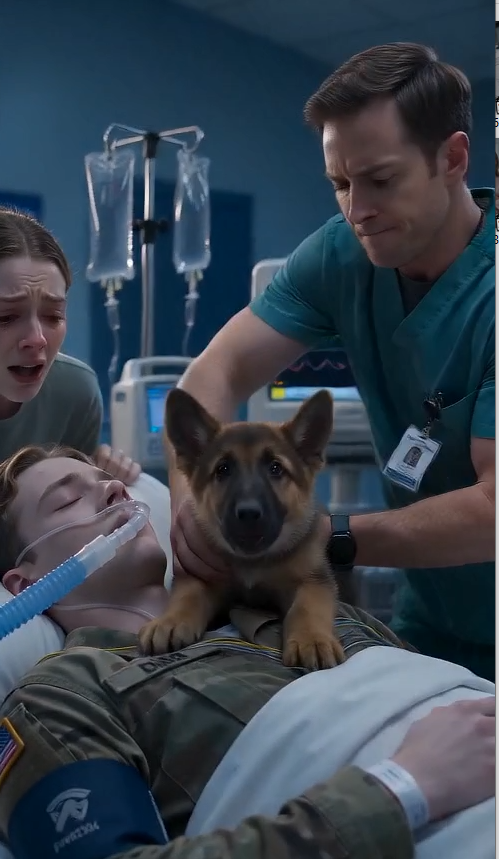
FINAL PART: The Voices That Brought Him Home
Caleb did not return to his old life.
Not exactly.
The Army offered him medical leave, then a pathway into investigative training and K-9 welfare oversight if his recovery allowed it. He could no longer run five miles at dawn. He could not stand too long without pain. Some words came slowly when he was tired.
But he was alive.
And Caleb Mercer had never wasted a second life gave him.
Nora moved into his house near base for six months.
At first, she said it was because he needed help.
Then Caleb pointed out that she kept eating his cereal and rearranging his medicine cabinet.
She said, “That’s called love.”
He said, “That’s called command theft.”
She cried because he sounded like himself.
Scout and Echo grew fast.
Too fast.
Their paws became huge.
Their ears stood up.
Their bodies filled out until the tiny puppies from the ICU looked like a memory someone had wrapped in fur and given teeth.
Caleb trained them every morning in the backyard.
Not for combat.
Not for danger.
For search, comfort response, scent detection, and therapy work for injured service members.
The first command he kept was the one that saved him.
“Home.”
Every time he said it, both dogs came straight to him.
No hesitation.
No confusion.
Home meant Caleb.
Home meant safety.
Home meant the voice they had followed into an ICU when doctors thought they were only making noise.
Dr. Mason visited once after Caleb was discharged.
He stood awkwardly on the porch with a basket of dog treats and an expression like he would rather perform surgery on himself than apologize.
“I was wrong,” he said.
Caleb leaned on his cane.
“About the dogs?”
“About your sister.”
Nora, standing behind the screen door, froze.
Dr. Mason looked at her.
“I thought you were acting from grief. You were acting from knowledge.”
Nora swallowed.
“Both.”
He nodded.
“Fair.”
Dr. Hart stayed in contact too. She wrote a medical case study, with Caleb’s permission, about familiar sensory bonding, auditory recognition, and measurable neurological response in traumatic coma recovery.
She did not call it a miracle.
Nora appreciated that.
Miracle made it sound random.
This had not been random.
It had been love repeated enough times that the brain remembered the path back.
The trials took nearly a year.
Ben Larkin pleaded guilty first and testified against Voss.
Lieutenant Colonel Grant Voss fought until the dash camera footage, chemical records, forged logs, and Caleb’s testimony cornered him completely.
He was convicted.
Stripped of rank.
Sentenced to prison.
The contractor lost its military contracts. Its executives faced federal charges. The K-9 unit at Fort Ashwood was rebuilt under new oversight.
Moreno’s family received a formal apology and survivor benefits that had been delayed by the false report.
Mara received a corrected service record.
Caleb insisted on that.
“Dogs don’t read records,” Nora told him softly.
“No,” he said. “But people do.”
So Mara’s name was restored.
That mattered.
On the first anniversary of Caleb waking up, Nora brought him back to the hospital.
Not to the ICU room.
He was not ready for that.
They stopped outside the garden courtyard instead. Dr. Hart met them there, along with two nurses who had been on shift the day Scout and Echo jumped the machines into chaos.
Scout and Echo wore clean blue training vests.
Echo tried to sniff a trash can.
Scout leaned against Caleb’s bad leg like a guard.
Dr. Hart smiled.
“They’re a little bigger than I remember.”
Caleb looked down.
“They’re still terrible at hospital manners.”
Nora laughed.
That sound meant more to him than any award.
Later that afternoon, they drove to the military cemetery where Mara’s first handler, Staff Sergeant Luis Moreno, had a memorial stone.
Caleb moved slowly with his cane.
Nora did not rush him.
Scout and Echo walked on either side, calm as if they knew where they were.
Caleb placed Mara’s old collar at the base of the stone.
Then he stood there a long time.
“I’m sorry it took so long,” he whispered.
Nora looked at her brother.
For months, she had thought saving Caleb meant getting him to open his eyes.
Now she understood that was only the beginning.
Saving someone also meant staying while they learned how to live with what happened.
It meant listening when nightmares woke him.
It meant letting him be angry.
It meant not treating survival like an easy happy ending.
But there was happiness.
Real happiness.
Quiet happiness.
The kind built from morning coffee, barking dogs, physical therapy victories, bad jokes, and the first time Caleb drove again with Nora pretending not to cry in the passenger seat.
One evening, long after the trials were over, Caleb sat on the back porch while Scout and Echo chased each other through the grass.
Nora brought him lemonade and sat beside him.
“You scared me,” she said.
Caleb looked at her.
“I know.”
“You’re not allowed to do that again.”
“Yes, ma’am.”
She leaned her head against his shoulder.
For a while, they watched the dogs run through the golden light.
Then Caleb said, “I heard you.”
Nora went still.
“In the ICU?”
He nodded.
“Not words at first. Just… sound. Then the puppies. Then you saying home.”
Her eyes filled.
“I thought I was losing you.”
“I was trying to find you.”
Scout came bounding up the porch steps, Echo right behind him.
Caleb held out one hand.
“Home.”
Both dogs came straight to him.
Nora started crying before she could stop herself.
Caleb put an arm around her.
Not strong like before.
Not effortless.
But enough.
The brother who had raised her was still there.
Changed.
Scarred.
Alive.
And the two puppies everyone tried to remove from the ICU had become the bridge back to him.
Not machines.
Not medals.
Not sealed folders.
Two small voices.
Two warm bodies.
May you like
One word repeated with love until a soldier lost in darkness remembered where he belonged.
If you were Nora, would you have broken ICU rules to bring the puppies to Caleb’s bedside?