FINAL PART: The Rank That Couldn’t Save Him
FINAL PART: The Rank That Couldn’t Save Him
At the final court-martial, Brock Sullivan stood in uniform for the last time.
No command patch.
No confident smile.
No formation behind him.
Just a man surrounded by the truth he had spent months trying to bury.
He was found guilty of dereliction of duty, obstruction, falsification of official records, assault on Captain Hayes, retaliation, and conduct unbecoming an officer.
The most serious findings centered on Caleb Ross.
The court ruled that Brock had knowingly ignored emergency stop procedures, delayed medical intervention, and then helped falsify records to protect himself and his command reputation.
Diane Ross sat in the front row.
Avery sat beside her.
When the judge read the findings, Diane reached for Avery’s hand.
Avery took it.
Brock was dismissed from service.
He lost his rank.
His benefits.
His pension.
His honor.
He received confinement.
The officers who helped alter reports faced separate charges and administrative separation. Lieutenant Ellison, who had finally told the truth, accepted punishment for staying silent but was allowed to testify fully in the reforms that followed.
Admiral Whitaker issued a public statement.
Not polished.
Not empty.
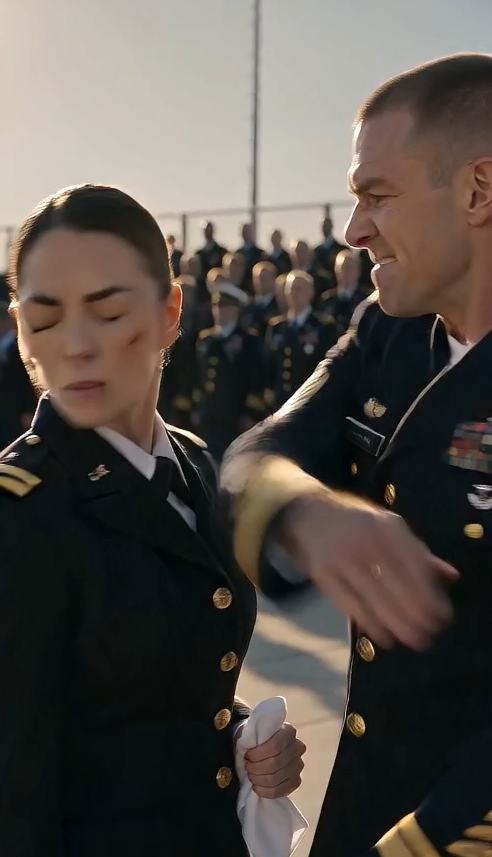
He stood at the same parade field where Brock had slapped Avery and addressed the formation directly.
“Rank is not ownership,” he said. “Command is not a shield for cruelty. And no service member’s life will be reduced to paperwork because the truth is inconvenient.”
Then he turned toward Diane Ross.
“Mrs. Ross,” he said, voice rougher now, “your son asked for help. He should have received it. The United States Navy failed him. Today, we say that clearly.”
Diane covered her mouth.
For a long time, she couldn’t stand.
Then Avery helped her up.
The entire formation came to attention.
Not for Brock.
Not for power.
For Caleb.
For the truth.
For the mother who had been called emotional when she had been right all along.
Months passed.
The training program was rebuilt.
Emergency stop protocols were rewritten and enforced by independent safety officers.
Anonymous complaints could no longer be buried inside a command.
Every high-risk exercise required external review.
And Captain Avery Hayes, once dismissed as a harmless administrative officer, became the officer commanders warned each other about for a very different reason.
Not because she destroyed careers.
Because she refused to let rank destroy people.
Her cheek healed.
The cut near her mouth faded.
But the video of her standing still after the slap became something larger than scandal.
Young officers shared it quietly.
Then openly.
Not because she fought back with force.
Because she stayed controlled when a powerful man lost control.
Because she did not scream.
Because she did not fold.
Because she looked him in the eye and told the truth before anyone else was brave enough to say it.
One afternoon, Diane Ross visited Avery’s office.
She carried a small wooden case.
Inside was Caleb’s service coin.
“I want you to have this,” Diane said.
Avery shook her head.
“Ma’am, I can’t.”
“Yes,” Diane whispered. “You can. My son tried to tell the truth. You made sure the world heard him.”
Avery’s eyes burned.
She accepted the coin with both hands.
Then Diane looked at the folded white handkerchief on Avery’s desk.
The same one she had given her before the investigation.
The same one Avery had held on the parade field.
The same one that still carried a faint stain from the day Brock Sullivan mistook silence for weakness.
Diane touched it gently.
“I gave you that because I thought you might need courage,” she said.
Avery smiled through tears.
“No, ma’am. You gave it to me because Caleb already had it.”
Diane broke then.
Avery hugged her.
Not as an officer.
As the woman who had carried her son’s truth across a field full of people too afraid to speak.
Later that evening, Avery walked alone across the parade ground.
The sun was lower now.
Softer.
The concrete no longer looked like a battlefield.
She stopped near the place where Brock had slapped her.
For a moment, she could almost hear the echo.
Remember my rank.
Avery touched the service coin in her pocket.
Then she looked toward the empty review stand.
Rank had not saved him.
Fear had not saved him.
The truth had waited.
May you like



And when it finally stood up, it sounded like a thousand silent witnesses remembering how to breathe.
If you had been standing in that formation, would you have stayed silent—or stepped forward after seeing Avery get slapped?