PART 3: The Name Carter Never Wanted to Hear
PART 3: The Name Carter Never Wanted to Hear
Rachel Reed did not build her reputation with speeches.
She built it by showing up when things went wrong.
Years before Mason stood in that gym, Rachel had been assigned to a classified maritime special operations program that paired elite operators with advanced military working dogs.
It was dangerous work.
Quiet work.
The kind no one mentioned at school assemblies.
The kind that never appeared on glossy recruitment posters.
Rachel was good at it because she did not waste movement.
She did not waste words.
And she never treated the dogs like equipment.
To her, every dog had a mind.
A memory.
A limit.
A choice.
That belief made her respected by handlers.
It also made her inconvenient to officers who only cared about results.
One of those officers was Carter.
Back then, he was ambitious, polished, and obsessed with being attached to elite units even when he had not earned their trust.
He wanted headlines.
Rachel wanted standards.
They clashed immediately.
Carter thought dogs could be pushed until they broke.
Rachel thought breaking a dog meant breaking the team.
Carter cut rest cycles.
Rachel wrote formal objections.
Carter rushed training drills.
Rachel stopped them when conditions became unsafe.
Carter called her difficult.
Rachel called him dangerous.
Then came the night that changed everything.
A joint training exercise went wrong during a coastal warehouse operation. One young handler was separated from his team. Two dogs alerted to a blocked service tunnel, but Carter dismissed the alert as “noise.”
Rachel did not.
She followed the dogs.
Inside that tunnel, she found the missing handler alive but trapped, barely conscious, with one dog pressed against him for warmth and the other refusing to leave the blocked exit.
Rachel led the rescue.
Carter wrote the report.
His version made him look decisive.
Her version made him look reckless.
Only one version had evidence.
Rachel’s.
Helmet audio.
Dog-cam footage.
Handler testimony.
Time stamps.
After the investigation, Carter lost his chance at advancement inside the program.
He was not court-martialed, but he was quietly moved away from operational K-9 work.
Officially, it was called reassignment.
Privately, Carter called it betrayal.
He blamed Rachel.
Not his decisions.
Not his ego.
Rachel.
And because much of the program remained classified, he knew she could not walk into public rooms and explain the full truth.
So he talked around her.
Implied she exaggerated.
Suggested her role was administrative.
Told people the “legend of Rachel Reed” was bigger than the woman herself.
Rachel ignored it.
She had a son to raise.
A unit to protect.
Dogs to train.
She had no interest in fighting a man who needed her attention to feel important.
But Carter never forgot.
And when he heard Mason say her name in that gym, he saw an opportunity.
Not to recruit.
Not to teach.
To punish.
A boy for his mother’s courage.
That was why he ripped the microphone away.
That was why he laughed.
That was why he pushed Mason’s shoulder.
Carter thought Rachel was not there.
He thought Mason was alone.
He thought a quiet teenage boy with a retired working dog would fold under public humiliation.
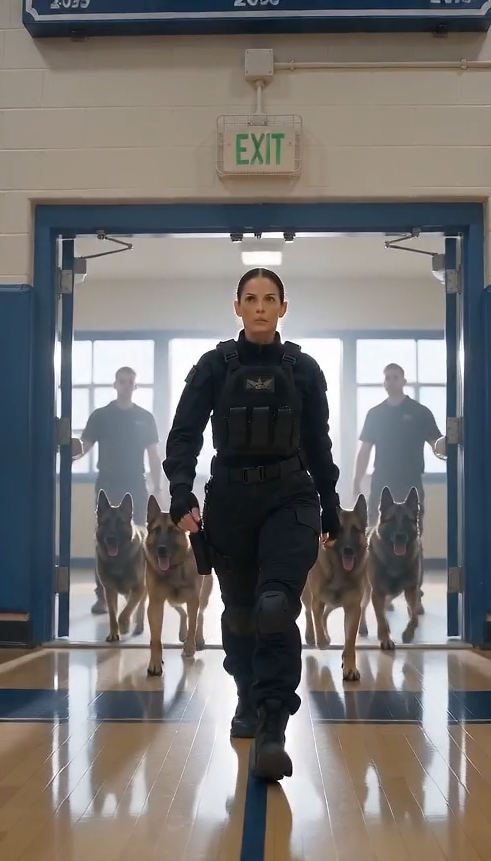
What Carter did not know was that Rachel was already in the building.
She had been scheduled for the second half of the assembly.
Not as a guest.
As the commander of the demonstration unit.
The senior officer beside Carter had known.
The school principal had known.
The dogs waiting outside the gym had known her voice before she ever reached the door.
And Titan had heard her coming before anyone else did.
That was why his ears turned toward the back entrance.
That was why he stood taller.
That was why he stopped Mason from stepping back.
Because Titan knew what Carter had forgotten.
Rachel Reed did not arrive loudly.
May you like
But when she arrived, everyone noticed.
👉 Carter mocked Mason because he thought Rachel’s truth was classified—but the unit waiting outside the gym was living proof of who she really was.