Chapter 12 - No More Accidents
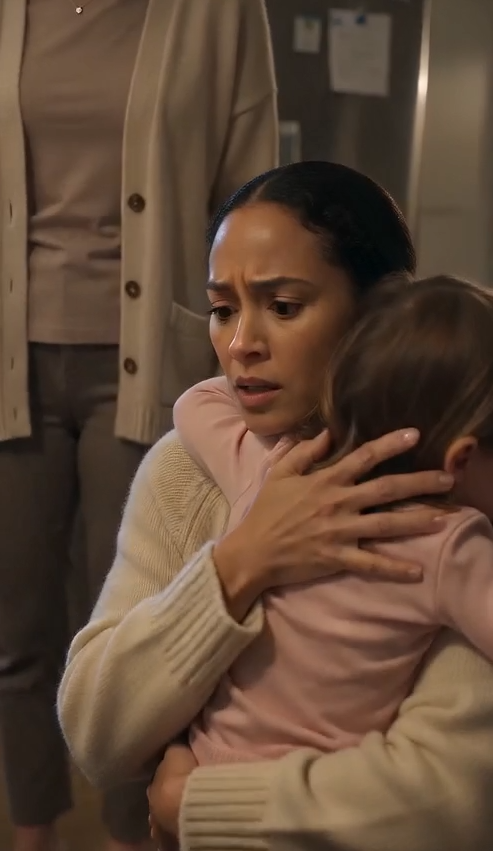
Three years later, Zoey barely remembered the dining room.
She remembered pieces.
A loud sound.
Her mother’s sweater.
The red plate.
The word safe.
Mostly, she remembered safe.
That was the miracle.
Children do not always need every detail of justice to heal.
They need a life that proves the danger ended.
Maya kept the folder.
Not on the kitchen island anymore.
In a locked cabinet.
Inside were the photos, the daycare notes, the reports, the financial audit, the court orders, and the first drawing Zoey made in therapy.
A stick figure girl holding a plate.
Above it, in Ms. Ellen’s handwriting, Zoey’s words:
My food is mine.
Maya cried every time she saw it.
Thomas became a different kind of father.
Not perfect.
Present.
He learned to see small changes.
Zoey going quiet.
Zoey hiding behind Maya.
Zoey asking the same question twice because she needed reassurance.
He stopped saying, “She’s fine.”
He started asking, “What is she telling us?”
That sentence saved more than one moment.
Their marriage healed slowly.
There were hard nights.
Maya was angry longer than Thomas expected.
Thomas was ashamed longer than Maya knew what to do with.
But they kept choosing truth.
No pretending.
No rushing.
No asking Maya to comfort him for guilt he needed to carry himself.
That was why they survived.
One spring afternoon, Zoey came home from preschool with a certificate for sharing snacks with a classmate.
She ran into the kitchen waving it.
“I shared crackers with Mia!”
Maya smiled.
“That was kind.”
Zoey climbed onto a chair.
“But I wanted to.”
Thomas looked at Maya.
That difference mattered.
Sharing because she wanted to.
Not because an adult scared her.
Not because love would be taken.
Not because food was a test.
Zoey opened the pantry and picked a snack.
Then looked at Thomas.
“Mine?”
He smiled softly.
“Yours.”
She grinned.
“Safe.”
“Yes,” he said. “Safe.”
Carol never regained unsupervised access.
Years later, after completing some court requirements, she was allowed to submit a request for supervised therapeutic contact.
Maya and Thomas discussed it with Zoey’s therapist.
Not with guilt.
Not with pressure.
With Zoey’s well-being first.
The therapist asked Zoey, now five, if she wanted to see Grandma Carol.
Zoey thought for a long time.
“Is she still mean?”
The therapist answered carefully.
“She is working on making better choices.”
Zoey frowned.
“Can she make better choices not near me?”
Maya closed her eyes.
Thomas put a hand over his mouth.
The therapist nodded.
“Yes, she can.”
So the answer was no.
Not forever.
Not as revenge.
As protection.
Carol was informed through attorneys.
She sent no apology.
Only silence.
That silence was finally acceptable.
The family no longer lived around her response.
Jackson grew up more than anyone expected.
He visited once a year at first, always with permission, never touching Zoey without asking.
At nineteen, he brought her a small wooden toy car he had made in shop class.
“I know it’s late,” he told Maya quietly, “but I wanted to give her something that wasn’t taken from anyone.”
Maya accepted it.
Zoey painted it purple.
Life moved.
The shelves made from Carol’s old chair stayed in the playroom. They held books, blocks, a toy doctor kit, and a basket of pretend food.
One evening, Maya found Zoey hosting a tea party for stuffed animals.
She placed one plastic sausage on each plate.
Then announced, “Everybody gets some. And if you want more, you ask nice.”
Thomas laughed from the doorway.
Maya smiled.
Then Zoey added very seriously, “And no hitting babies.”
The room went quiet for half a second.
Then Maya walked over and kissed the top of her head.
“Exactly.”
Zoey looked up.
“Did I say it good?”
Maya’s eyes filled.
“You said it perfectly.”
That night, after Zoey slept, Maya opened the locked cabinet and looked at the folder one last time.
No more accidents.
That phrase had once been a line spoken through terror while holding a crying toddler.
Now it meant something else.
No more calling cruelty discipline.
No more calling neglect a mistake.
No more calling financial control family help.
No more letting Carol rename harm until everyone else doubted their eyes.
Maya closed the folder.
Then she placed it in a storage box labeled:
Proof of what ended.
Not proof of who they were.
Because they were not the worst thing Carol had done.
They were the life that came after it.
A warm kitchen.
A little girl with ketchup on her face.
A father who finally learned protection was not disloyalty.
A mother who stopped apologizing for believing what she saw.
May you like

And a child who knew, deep in her bones, that what belonged to her could be shared with love—but never taken by fear.
If you were Maya, would you ever allow Carol near Zoey again after all the “accidents” she tried to hide?