FINAL PART: The Table He Could Never Own Again
FINAL PART: The Table He Could Never Own Again
The official correction came six weeks later.
It was not loud.
It did not trend.
It did not undo years in a single page.
But it mattered.
The Navy amended the Gulf mission record.
The reroute that saved Reed’s team was credited to Lieutenant Commander Claire Hayes and the intelligence team she led.
The award citation was corrected.
Reed’s inflated commendation was reduced.
His name was removed from a leadership program.
His pending promotion disappeared.
Then the charges followed.
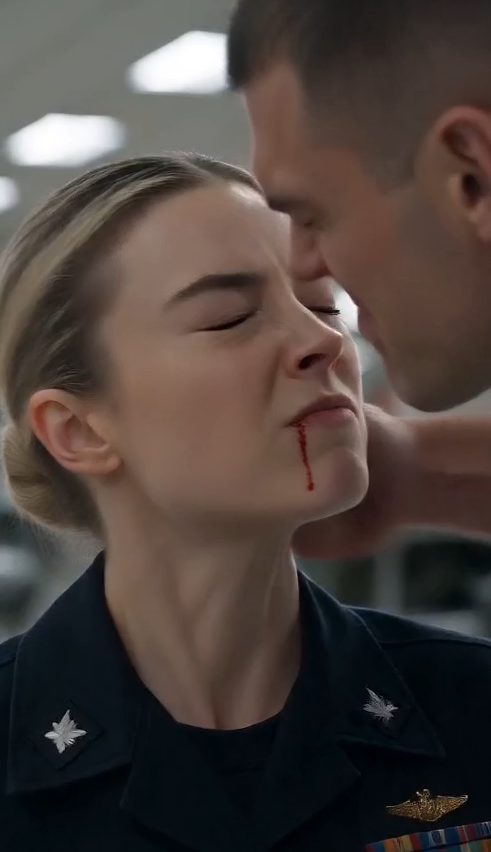
Assault on a commissioned officer.
Conduct unbecoming.
Falsification of training records.
Retaliation.
Dereliction of duty.
The man who once owned every room now entered them with counsel beside him.
Not recruits.
Not admirers.
Counsel.
Miller’s discharge was reviewed.
His medical record corrected.
Lieutenant Park’s complaint was reopened and validated.
The corpsman who had been ignored was promoted.
The recruits who raised their hands were protected, reassigned, and given a second chance to train under leaders who understood the difference between hardship and abuse.
Captain Moore accepted punishment for helping hide Reed’s records.
He did not ask for sympathy.
“I should have spoken sooner,” he said.
Claire respected that more than any excuse.
As for Reed, the Navy did not treat him like a legend anymore.
It treated him like evidence.
His reputation cracked.
Then collapsed.
Not because Claire destroyed him.
Because the truth finally had somewhere to stand.
Months later, Claire returned to the mess hall.
The same building.
The same long tables.
The same floor where her tray had fallen.
For a moment, every sound sharpened.
The scrape of chairs.
The clatter of silverware.
The low voices of recruits trying to act normal.
Her ribs had healed.
Her lip had healed.
But some rooms remember pain before the body does.
Admiral Bennett walked beside her.
“You sure?”
Claire looked at the table near the center of the room.
The one Reed had treated like a throne.
“I’m sure.”
She picked up a tray.
Coffee.
Eggs.
Toast.
Nothing dramatic.
Then she walked to that table and sat down.
No one stopped her.
No one laughed.
No one looked away.
A young recruit stood with his tray nearby, unsure whether he could sit.
Claire looked up.
“There’s room.”
He sat.
Then another sailor.
Then Lieutenant Park.
Then Miller, visiting the base for the first time since his discharge review began.
He moved slowly, still carrying old pain in his body, but his shoulders were higher than before.
Claire watched him set his tray down.
“You okay?” she asked.
Miller looked around the mess hall.
Then gave a small smile.
“Getting there, ma’am.”
That was enough.
Across the room, a new instructor corrected a recruit’s posture with patience instead of humiliation.
A corpsman laughed with two junior sailors.
No one owned the table.
No one had to earn the right to eat.
The mess hall had become ordinary again.
And sometimes ordinary is what safety looks like.
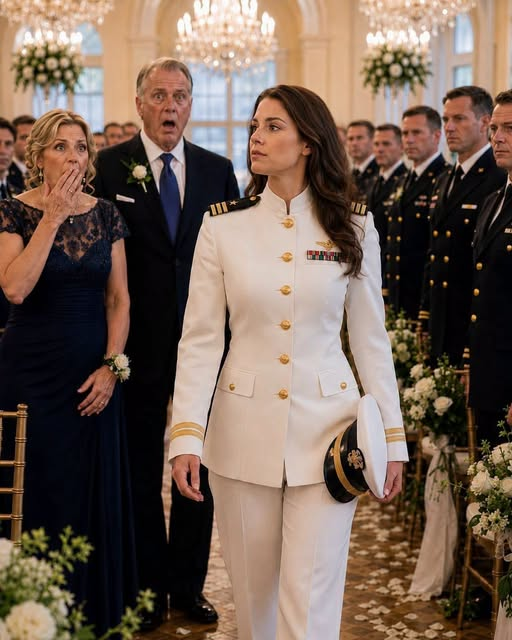
Later that afternoon, Bennett called Claire to the auditorium.
She thought it was another review meeting.
It was not.
The room was full.
Sailors.
Officers.
Analysts.
Medics.
People whose work happened in boats, behind screens, in clinics, in training lanes, in rooms where no one ever clapped.
Bennett stood at the podium.
He read the corrected citation aloud.
This time, Claire’s name was not missing.
When he finished, he looked at her.
“Lieutenant Commander Hayes, your work saved lives before most of this room knew your name. Your courage afterward saved more.”
Claire stood still.
She had faced Reed without crying.
But this almost broke her.
Not because of the medal.
Because of the analysts in the back row, sitting straighter.
Because of the young female officer wiping her eyes.
Because of Miller clapping first.
Then Park.
Then the whole room.
Claire accepted the corrected citation.
Not as proof that she belonged.
She had never needed Reed to decide that.
She accepted it because silence had finally lost.
That evening, she walked past the mess hall one more time.
Through the window, she saw sailors eating at the center table.
Different uniforms.
Different jobs.
Same Navy.
No throne.
No fear.
No “office girls.”
Just people who served.
Claire smiled slightly and kept walking.
Chief Reed had once believed warfighters were defined by who could hit hardest.
Claire knew better.
Real strength was knowing when to protect.
When to speak.
When to stand.
May you like



And when to make sure the next person at the table would never have to bleed just to be seen.
What would you have done if you saw a famous soldier humiliate someone in public and everyone else was too afraid to speak?